ADC1
Alternative Desert Cities 1
Miller Urban Plan

Alternative Desert Cities 1

Urban plan illustrating a new lifted infrastructure above the highway interchange by student Genevieve MillerUrban plan illustrating a new lifted infrastructure above the highway interchange by student Genevieve MillerUrban plan illustrating a new lifted infrastructure above the highway interchange by student Genevieve MillerUrban plan illustrating a new lifted infrastructure above the highway interchange by student Genevieve Miller

RELATED RESEARCH IMAGES

RELATED PROJECT IMAGES

OTHER PROJECTS

Expanding the mission of the local Biscayne National Park Institute, MICROGROVE is a living research community designed for scientists, ecologists, researchers, and eco-tourists, dedicated to the study, restoration, and increased social awareness of coastal ecosystems.
The Urban Test Object (UTO) serves as a large-scale intervention that accelerates our relationship with the future city. Rather than solving issues like density, infrastructure, or access, the UTO heightens awareness of the rapid urban transformations shaping our future.
Coney Island will remain a MUTANT appendage at the farthest shore of New York City. Coney is an agglomeration of all of its histories and should continue to simultaneously move each agenda forward. Coney will continue to evolve through mutations— this vision will accelerate its hybridity.
Dimensions.com is an ongoing reference database of dimensioned drawings documenting the standard measurements and sizes of the everyday objects and spaces that make up our world.
The challenge of creating a pair of studio apartments that can fill a lifted 16'x16' void necessitates the creation of a quick, mobile, and opportunistic building system that can react to the found conditions of the site. Access to the site is limited and the ground must be free.
Utilizing built form as a strategic carrier of culture in opposition of the status quo, the Hellinikon project links the disconnected suburban mountain communities to the east with the sea to the west while splitting the Hellinikon International Airport and Olympic Park into distinct zones.
QTCT is tasked to blend these two identities onto one site—a give and take relationship between beach ambitions and urban necessities. QTCT is a sampling of two worlds: on one hand it is the embodiment of the language of the beach and on the other it is a detailed and exacting built urban space.
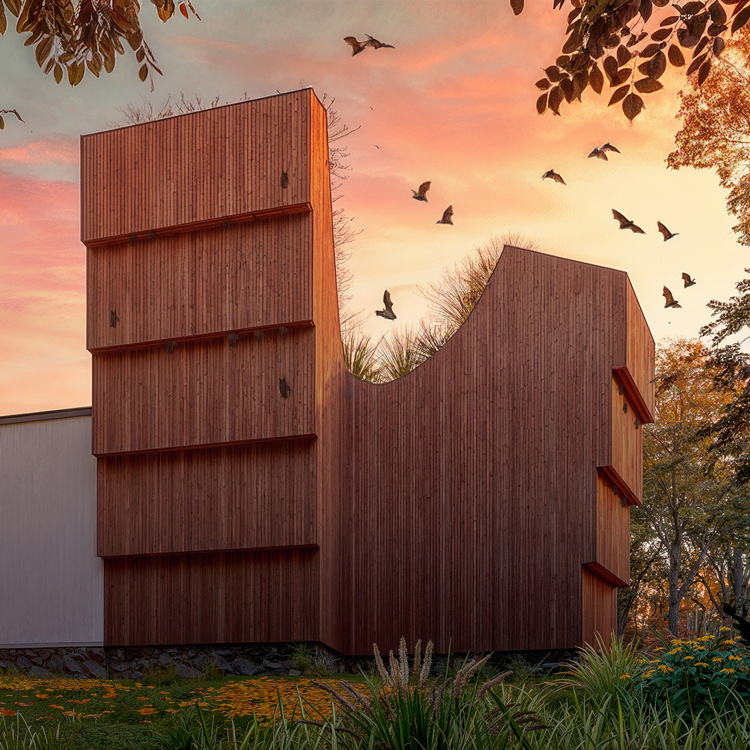
Bathaus is a small hybrid building that expands the visitor center at the Gropius House while simultaneously functioning as an ecologically sensitive bat sanctuary. Integrated directly into the architecture, a series of vertical slot bat habitats are carved into the façade and form.

OTHER RESEARCH