ADC1
—
—
Alternative Desert Cities 1
Synacek Isometric Cluster Massing

Alternative Desert Cities 1

Isometric drawing of a concept for a self-constructed cellular city cluster by student Andrew SynacekIsometric drawing of a concept for a self-constructed cellular city cluster by student Andrew SynacekIsometric drawing of a concept for a self-constructed cellular city cluster by student Andrew SynacekIsometric drawing of a concept for a self-constructed cellular city cluster by student Andrew Synacek

RELATED RESEARCH IMAGES

RELATED PROJECT IMAGES

OTHER PROJECTS

The Urban Test Object (UTO) serves as a large-scale intervention that accelerates our relationship with the future city. Rather than solving issues like density, infrastructure, or access, the UTO heightens awareness of the rapid urban transformations shaping our future.
The Butterfly Theater is a living pavilion—part sculpture, part habitat, part playground. It takes inspiration from the elegance of flamingos and the presence of butterflies in Miami Beach, transforming the park’s open center into a place of movement, color, and quiet spectacle.
Dimensions.com is an ongoing reference database of dimensioned drawings documenting the standard measurements and sizes of the everyday objects and spaces that make up our world.
Coney Island will remain a MUTANT appendage at the farthest shore of New York City. Coney is an agglomeration of all of its histories and should continue to simultaneously move each agenda forward. Coney will continue to evolve through mutations— this vision will accelerate its hybridity.
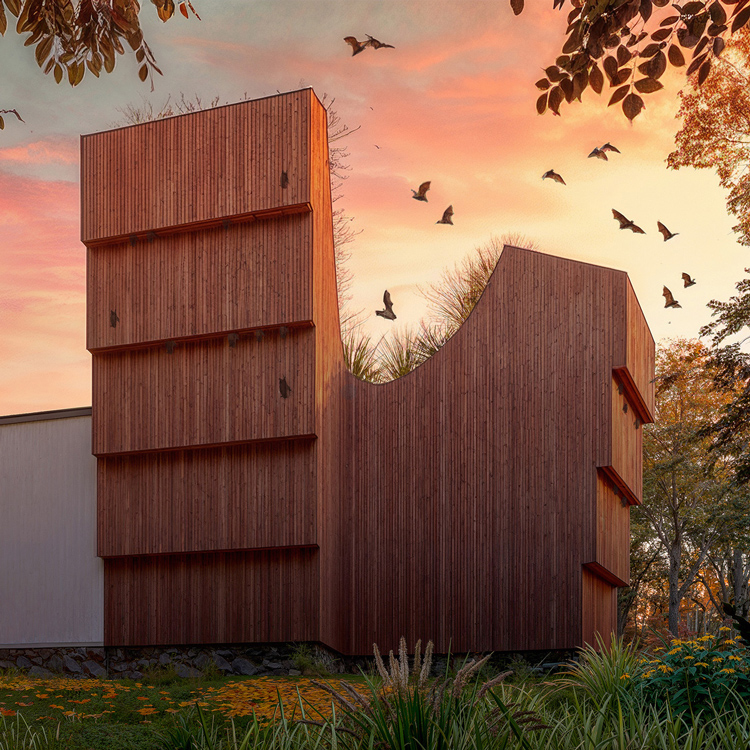
Bathaus is a small hybrid building that expands the visitor center at the Gropius House while simultaneously functioning as an ecologically sensitive bat sanctuary. Integrated directly into the architecture, a series of vertical slot bat habitats are carved into the façade and form.
The CART live/work housing prototype adds a vertical profile to downtown while converting an underutilized public path into an urban gesture by introducing of a specialized food cart zone in New Haven. The CART residents would rent and appropriate the moving space as a means of expanding their zone.
Space has become redundant again. Popular culture is uninterested in the goings-on in space. Once achieved, mans absurd relation with space becomes yesterdays news. To become relevant to the public, CASIS must be an amenity and not a mission. Instead of promoting an HQ, make it a public interface.
The RACA project must meet two demands: A. REFLECTION (museum) or B. CONTINUATION (practice + addition). The current program and its stagnancy has left the site forgotten—it is a typical static museum on a living site. The site and addition must constantly change through the participation of people.

OTHER RESEARCH