ADC1
Alternative Desert Cities 1
Pedregon Urban Perspective

Alternative Desert Cities 1

Perspective illustrating the scale of an linear rammed-earth housing infrastructure in the suburbs by student Rikkie PedregonPerspective illustrating the scale of an linear rammed-earth housing infrastructure in the suburbs by student Rikkie PedregonPerspective illustrating the scale of an linear rammed-earth housing infrastructure in the suburbs by student Rikkie PedregonPerspective illustrating the scale of an linear rammed-earth housing infrastructure in the suburbs by student Rikkie Pedregon

RELATED RESEARCH IMAGES

RELATED PROJECT IMAGES

OTHER PROJECTS

The CART live/work housing prototype adds a vertical profile to downtown while converting an underutilized public path into an urban gesture by introducing of a specialized food cart zone in New Haven. The CART residents would rent and appropriate the moving space as a means of expanding their zone.
In Tempe there are two pedestrian axes: Mill Avenue and Palm Walk. Mill Avenue is successful and Palm Walk is not. Is there a way to make the palm trees useful to the students? The PEP structure is powered by buried hydraulic pressure systems giving vertical movement to the layer/palm interface.
The Miami Beach House is constructed as a series of platformed spaces that continuously step upward within a tropically climatized shell. Continuing the structural experiments of the Metabolist movement, thirteen modular concrete platforms branch from two vertical cores.
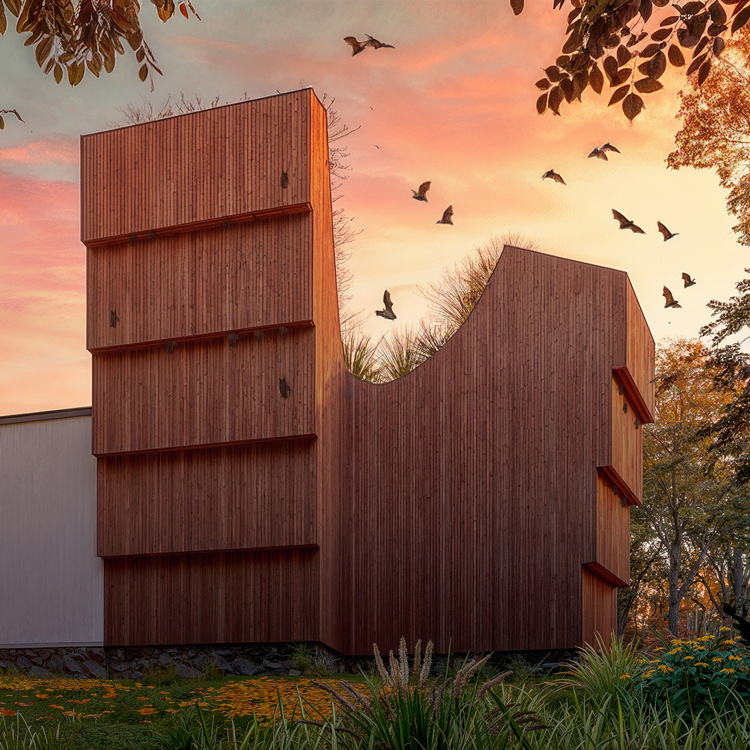
Bathaus is a small hybrid building that expands the visitor center at the Gropius House while simultaneously functioning as an ecologically sensitive bat sanctuary. Integrated directly into the architecture, a series of vertical slot bat habitats are carved into the façade and form.
QTCT is tasked to blend these two identities onto one site—a give and take relationship between beach ambitions and urban necessities. QTCT is a sampling of two worlds: on one hand it is the embodiment of the language of the beach and on the other it is a detailed and exacting built urban space.
The Craft School is a participatory design and construction initiative that places students at the center of creating their own learning environment. It recognizes that education is not only about what happens inside the classroom, but also how the classroom comes to be.
The challenge of creating a pair of studio apartments that can fill a lifted 16'x16' void necessitates the creation of a quick, mobile, and opportunistic building system that can react to the found conditions of the site. Access to the site is limited and the ground must be free.
The Urban Test Object (UTO) serves as a large-scale intervention that accelerates our relationship with the future city. Rather than solving issues like density, infrastructure, or access, the UTO heightens awareness of the rapid urban transformations shaping our future.

OTHER RESEARCH