ADC3
Alternative Desert Cities 3
Bennett Golf Course Plan

Alternative Desert Cities 3

Neighborhood plan of a converting a golf course plan into a housing plan by student Lauren BennettNeighborhood plan of a converting a golf course plan into a housing plan by student Lauren BennettNeighborhood plan of a converting a golf course plan into a housing plan by student Lauren BennettNeighborhood plan of a converting a golf course plan into a housing plan by student Lauren Bennett

RELATED RESEARCH IMAGES

RELATED PROJECT IMAGES

OTHER PROJECTS

Scaffolding is often seen as a temporary urban necessity—functional, but rarely celebrated. This project reimagines scaffolding as an architectural intervention and public art piece throughout Española Way, transforming it into a vibrant, interactive element in Miami Beach’s urban fabric.
Dimensions.com is an ongoing reference database of dimensioned drawings documenting the standard measurements and sizes of the everyday objects and spaces that make up our world.
Framework: Inverted Square Pyramid (FW:ISP) reimagines the traditional pyramid by flipping it upside down, shifting its focus from the cosmos to the people. The structure’s apexes become seating points within a flexible, interactive framework that encourages public engagement and play.
QTCT is tasked to blend these two identities onto one site—a give and take relationship between beach ambitions and urban necessities. QTCT is a sampling of two worlds: on one hand it is the embodiment of the language of the beach and on the other it is a detailed and exacting built urban space.
The Miami Beach House is constructed as a series of platformed spaces that continuously step upward within a tropically climatized shell. Continuing the structural experiments of the Metabolist movement, thirteen modular concrete platforms branch from two vertical cores.
Planes, frames, and volumes are fundamentals to all assembly logics. With the proliferation of additive production methods, the possibility of volumetric prefabricated components has the potential to radically alter the way that we conceive of construction and the permanence of building parts.
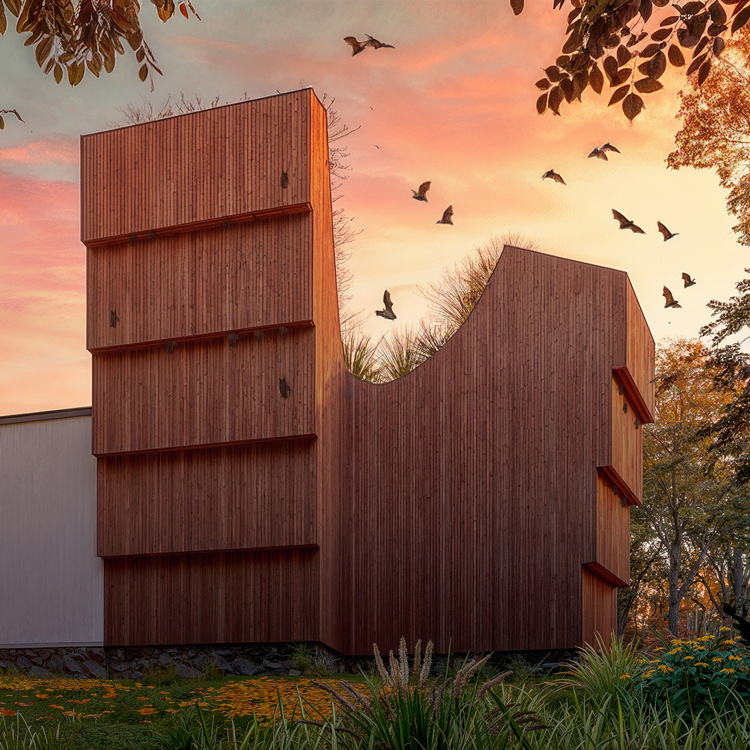
Bathaus is a small hybrid building that expands the visitor center at the Gropius House while simultaneously functioning as an ecologically sensitive bat sanctuary. Integrated directly into the architecture, a series of vertical slot bat habitats are carved into the façade and form.
The challenge of creating a pair of studio apartments that can fill a lifted 16'x16' void necessitates the creation of a quick, mobile, and opportunistic building system that can react to the found conditions of the site. Access to the site is limited and the ground must be free.

OTHER RESEARCH