ADC3
Alternative Desert Cities 3
Richards Urban Growth

Alternative Desert Cities 3

Axon drawings illustrating the potential timeline of growth for a lifted city in downtown Phoenix by student Brennan RichardsAxon drawings illustrating the potential timeline of growth for a lifted city in downtown Phoenix by student Brennan RichardsAxon drawings illustrating the potential timeline of growth for a lifted city in downtown Phoenix by student Brennan RichardsAxon drawings illustrating the potential timeline of growth for a lifted city in downtown Phoenix by student Brennan Richards

RELATED RESEARCH IMAGES

RELATED PROJECT IMAGES

OTHER PROJECTS

In Tempe there are two pedestrian axes: Mill Avenue and Palm Walk. Mill Avenue is successful and Palm Walk is not. Is there a way to make the palm trees useful to the students? The PEP structure is powered by buried hydraulic pressure systems giving vertical movement to the layer/palm interface.
Infrastructure as urban performance. Serving as both a backdrop to elegant theatrical dances and a framework for holding a wandering public, the Dance Machine enacts performance through both its program and its existence as a merged urban extension of the Queensboro Bridge.
The CART live/work housing prototype adds a vertical profile to downtown while converting an underutilized public path into an urban gesture by introducing of a specialized food cart zone in New Haven. The CART residents would rent and appropriate the moving space as a means of expanding their zone.
University Island is a swirling shapeshifter, in both the landscape and the architecture, that offers it’s undefined field of opportunities to the students and anticipates that each will discover and produce their own individual relationship with the island and their education.
The Urban Test Object (UTO) serves as a large-scale intervention that accelerates our relationship with the future city. Rather than solving issues like density, infrastructure, or access, the UTO heightens awareness of the rapid urban transformations shaping our future.
The Craft School is a participatory design and construction initiative that places students at the center of creating their own learning environment. It recognizes that education is not only about what happens inside the classroom, but also how the classroom comes to be.
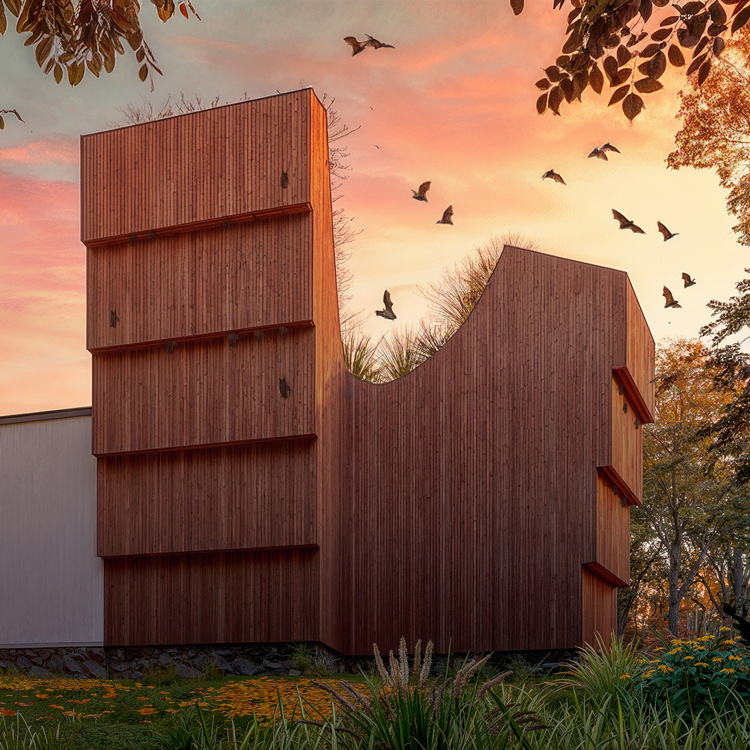
Bathaus is a small hybrid building that expands the visitor center at the Gropius House while simultaneously functioning as an ecologically sensitive bat sanctuary. Integrated directly into the architecture, a series of vertical slot bat habitats are carved into the façade and form.
Seating design is vital in fostering communal interactions in shared spaces. Rooted in the organic growth principles of the Metabolist movement and the transformational geometric language of digital Metaballs, Meta-Bench forms an experiential seating system which individuals can move and adjust.

OTHER RESEARCH