ADC3
Alternative Desert Cities 3
Ibarra Unit Typologies

Alternative Desert Cities 3

Series of unit typology studies with various interlocking forms within the walls of student Marcia Ibarra's housing volumesSeries of unit typology studies with various interlocking forms within the walls of student Marcia Ibarra's housing volumesSeries of unit typology studies with various interlocking forms within the walls of student Marcia Ibarra's housing volumesSeries of unit typology studies with various interlocking forms within the walls of student Marcia Ibarra's housing volumes

RELATED RESEARCH IMAGES

RELATED PROJECT IMAGES

OTHER PROJECTS

Seeing Park Avenue as an underutilized zone that connects four vibrant neighborhoods from 42nd Street to 144th Street, Infrastructural Infill is a study testing the potential to locate a combination of mixed-use housing and transportation in the residual spaces caused by urban infrastructure.
Framework: Inverted Square Pyramid (FW:ISP) reimagines the traditional pyramid by flipping it upside down, shifting its focus from the cosmos to the people. The structure’s apexes become seating points within a flexible, interactive framework that encourages public engagement and play.
In Tempe there are two pedestrian axes: Mill Avenue and Palm Walk. Mill Avenue is successful and Palm Walk is not. Is there a way to make the palm trees useful to the students? The PEP structure is powered by buried hydraulic pressure systems giving vertical movement to the layer/palm interface.
The CART live/work housing prototype adds a vertical profile to downtown while converting an underutilized public path into an urban gesture by introducing of a specialized food cart zone in New Haven. The CART residents would rent and appropriate the moving space as a means of expanding their zone.
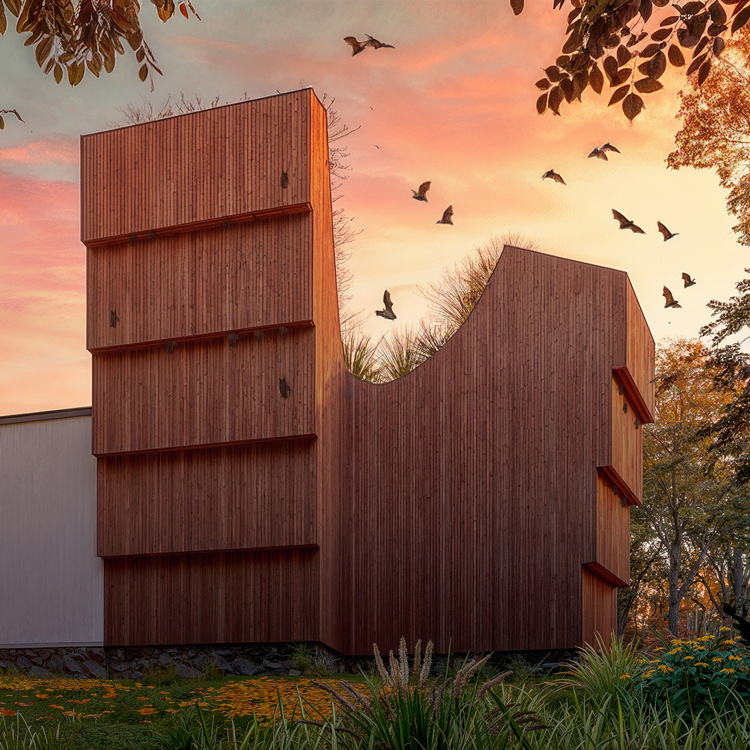
Bathaus is a small hybrid building that expands the visitor center at the Gropius House while simultaneously functioning as an ecologically sensitive bat sanctuary. Integrated directly into the architecture, a series of vertical slot bat habitats are carved into the façade and form.
The RACA project must meet two demands: A. REFLECTION (museum) or B. CONTINUATION (practice + addition). The current program and its stagnancy has left the site forgotten—it is a typical static museum on a living site. The site and addition must constantly change through the participation of people.
The GBN project sites itself as this link connecting the busiest night life district and revitalized neighborhood park in the north, the largest beach front in the city to the south, and establishes the cities first large public plaza and recreation fields adjacent to the new building.
Scaffolding is often seen as a temporary urban necessity—functional, but rarely celebrated. This project reimagines scaffolding as an architectural intervention and public art piece throughout Española Way, transforming it into a vibrant, interactive element in Miami Beach’s urban fabric.

OTHER RESEARCH