ADC3
Alternative Desert Cities 3
Munoz Future Concept

Alternative Desert Cities 3

Conceptual image of a dense future city born of organic forms that contrast existing Phoenix forms by student Brayan MunozConceptual image of a dense future city born of organic forms that contrast existing Phoenix forms by student Brayan MunozConceptual image of a dense future city born of organic forms that contrast existing Phoenix forms by student Brayan MunozConceptual image of a dense future city born of organic forms that contrast existing Phoenix forms by student Brayan Munoz

RELATED RESEARCH IMAGES

RELATED PROJECT IMAGES

OTHER PROJECTS

The CART live/work housing prototype adds a vertical profile to downtown while converting an underutilized public path into an urban gesture by introducing of a specialized food cart zone in New Haven. The CART residents would rent and appropriate the moving space as a means of expanding their zone.
Space has become redundant again. Popular culture is uninterested in the goings-on in space. Once achieved, mans absurd relation with space becomes yesterdays news. To become relevant to the public, CASIS must be an amenity and not a mission. Instead of promoting an HQ, make it a public interface.
Planes, frames, and volumes are fundamentals to all assembly logics. With the proliferation of additive production methods, the possibility of volumetric prefabricated components has the potential to radically alter the way that we conceive of construction and the permanence of building parts.
In Tempe there are two pedestrian axes: Mill Avenue and Palm Walk. Mill Avenue is successful and Palm Walk is not. Is there a way to make the palm trees useful to the students? The PEP structure is powered by buried hydraulic pressure systems giving vertical movement to the layer/palm interface.
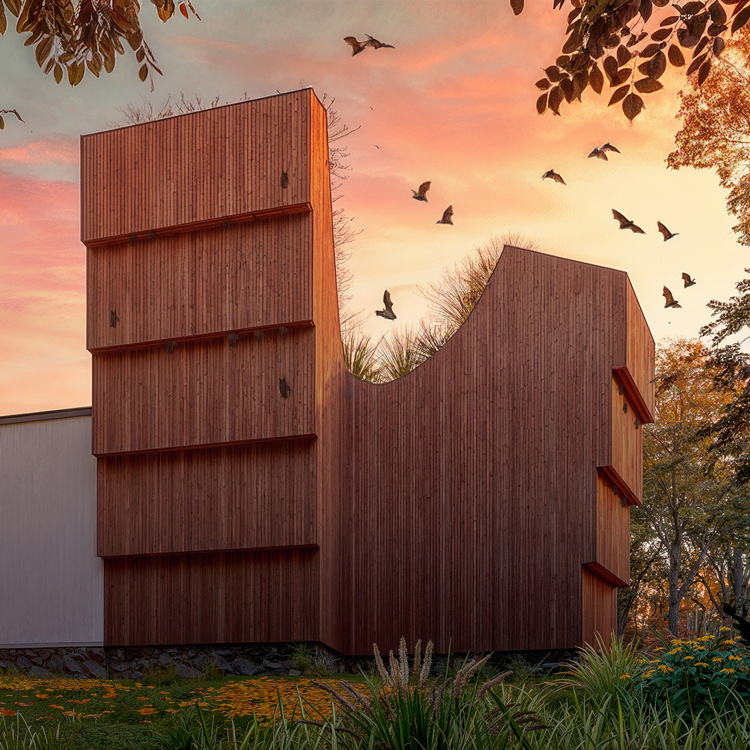
Bathaus is a small hybrid building that expands the visitor center at the Gropius House while simultaneously functioning as an ecologically sensitive bat sanctuary. Integrated directly into the architecture, a series of vertical slot bat habitats are carved into the façade and form.
Scaffolding is often seen as a temporary urban necessity—functional, but rarely celebrated. This project reimagines scaffolding as an architectural intervention and public art piece throughout Española Way, transforming it into a vibrant, interactive element in Miami Beach’s urban fabric.
The GBN project sites itself as this link connecting the busiest night life district and revitalized neighborhood park in the north, the largest beach front in the city to the south, and establishes the cities first large public plaza and recreation fields adjacent to the new building.
The Urban Test Object (UTO) serves as a large-scale intervention that accelerates our relationship with the future city. Rather than solving issues like density, infrastructure, or access, the UTO heightens awareness of the rapid urban transformations shaping our future.

OTHER RESEARCH